

Home » Specialties » Dental Lab Technician

Dental Lab Technician Careers: Job Duties, Education & Certification

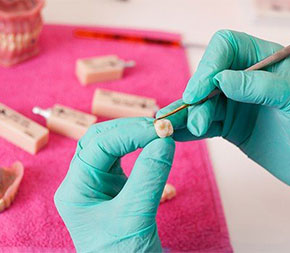
hands fixing tooth in lab
author-default

By: All Allied Health Staff

Updated: December 3, 2025

Home » Specialties » Dental Lab Technician

Dental Lab Technician Overview

  • What you’ll do: As a dental lab technician, you’ll fill orders from dentists for a variety of dental appliances. You’ll work with sophisticated equipment and a broad range of materials to create tooth replacements that are realistic and aesthetically pleasing, as well as functional.
  • Where you’ll work: Commercial dental laboratories, private dental offices, hospitals (including the U.S. Department of Veterans Affairs’ hospitals), dental schools, dental manufacturers and suppliers, private practice
  • Degree you’ll need: 2-year dental lab technician program leading to an associate’s degree or certificate
  • Median annual salary: $48,310

What Is a Dental Lab Technician?

A dental lab technician plays a crucial role in creating dental appliances like crowns, bridges, and dentures. They utilize impressions or molds of patients’ teeth to fabricate these custom-made dental devices. While working closely with dentists, dental lab technicians have limited direct contact with patients, focusing primarily on the precise craftsmanship and technical skills required for producing high-quality dental restorations. Often mistakenly confused with dental hygienists, they are however distinct, each skilled in their separate and specialized trade.

Dental Technician Job Description

Using a dentists’ detailed written directions, and molds of a patient’s teeth or oral soft tissues, you’ll make the following items:

  • Full dentures for patients who are missing all of their teeth
  • Removable partial dentures or fixed bridges for those who are missing only one or a few teeth
  • Crowns, which cover the tooth and are designed to restore its original size and shape
  • Veneers, which are bonded to the tooth surface to improve the appearance of discolored, worn, chipped, or misaligned teeth
  • Orthodontic appliances and splints used to help straighten and protect teeth

Dental lab technicians can also specialize in one of five areas: orthodontic appliances, crowns and bridges, complete dentures, partial dentures and ceramics.

Median Annual Dental Lab Technician Salary

The U.S. Bureau of Labor Statistics 2024 Occupational Employment Statistics reports the median annual salary for dental lab technicians as $48,310.

They list the following median annual salaries by state:

Dental Laboratory Technicians

National data

Median Salary: $48,310

Projected job growth: -4.7%

10th Percentile: $36,100

25th Percentile: $39,250

75th Percentile: $62,320

90th Percentile: $78,680

Projected job growth: -4.7%

State data

State Median Salary Bottom 10% Top 10%
Alabama $40,980 $30,110 $56,960
Alaska $59,150 $42,560 $103,260
Arizona $47,560 $36,330 $81,890
Arkansas $45,880 $30,670 $78,360
California $48,480 $37,850 $82,770
Colorado $63,170 $46,240 $90,650
Connecticut $51,480 $37,970 $71,200
Delaware $37,320 $37,320 $63,070
Florida $56,910 $36,540 $80,620
Georgia $48,440 $34,090 $77,790
Hawaii $41,600 $35,890 $66,040
Idaho $47,750 $36,000 $81,290
Illinois $50,500 $36,100 $79,760
Indiana $47,370 $32,350 $64,320
Iowa $48,560 $37,310 $70,180
Kansas $49,620 $38,710 $71,220
Kentucky $41,760 $35,250 $55,460
Louisiana $36,720 $20,560 $65,910
Maine $56,020 $43,520 $108,770
Maryland $49,850 $40,000 $95,750
Massachusetts $59,270 $42,420 $105,110
Michigan $48,720 $36,270 $76,590
Minnesota $57,180 $38,170 $73,880
Mississippi $37,390 $27,960 $73,730
Missouri $46,900 $36,330 $77,290
Montana $50,540 $34,510 $89,630
Nebraska $49,170 $38,080 $72,040
Nevada $50,620 $35,840 $86,410
New Hampshire $55,670 $38,640 $66,660
New Jersey $48,780 $31,620 $99,050
New Mexico $48,590 $33,930 $68,720
New York $54,140 $37,640 $79,180
North Carolina $49,460 $35,320 $75,850
North Dakota $56,540 $39,450 $81,920
Ohio $48,250 $36,600 $75,540
Oklahoma $48,480 $36,730 $78,730
Oregon $48,090 $38,100 $71,190
Pennsylvania $49,750 $34,820 $81,970
Rhode Island $57,520 $36,870 $68,040
South Carolina $39,920 $28,260 $79,830
South Dakota $44,610 $38,630 $80,290
Tennessee $43,970 $30,430 $77,700
Texas $41,900 $31,460 $74,960
Utah $45,770 $36,070 $78,790
Vermont $56,160 $39,350 $85,700
Virginia $48,510 $35,270 $79,680
Washington $56,360 $41,390 $82,160
West Virginia $36,970 $33,690 $67,040
Wisconsin $47,250 $37,070 $68,770

Source: U.S. Bureau of Labor Statistics (BLS) 2024 median salary; projected job growth through 2034. Actual salaries may vary depending on location, level of education, years of experience, work environment, and other factors. Salaries may differ even more for those who are self-employed or work part time.

Schooling

Although each program has unique entry requirements, a high school diploma or GED is a standard prerequisite for applying to an accredited dental lab technology program.

Some dental technicians begin careers without a college degree, but you’ll find it’s easiest to start your career by pursuing formal training through an accredited program. There are 2-year dental lab technician programs leading to an associate’s degree or certificate; a few 4-year bachelor’s programs are also available. These programs are offered at community colleges, vocational schools, technical colleges, universities and dental schools.

In addition to formal training, you’ll find the following skills will serve you well in your dental technician career:

  • Ability to do precision work with your hands
  • Ability to work independently
  • Attention to detail and aesthetics

Dental Lab Tech Certification

There is no license required for dental lab technicians, but optional certification is available. Certification recognizes a dental lab technician’s knowledge and technical skills. It involves passing an exam administered by the National Board for Certification in Dental Laboratory Technology. In order to take the certification exam, you must have completed an accredited dental laboratory technology program and have had two years of professional experience, or, if you’ve been trained on the job or through a non-accredited program, you can take the exam after five years of work experience as a dental lab technician. Upon passing the exam, you become a Certified Dental Technician (CDT).