
In this Article

By: Mariah Beckman

Professional insights: Dr. Meenal Agarwal
Optometric technician overview

Eyesight is one of the five senses, critical to everyday life. Helping others see clearly and comfortably can have a profound impact on their independence and their sense of wellbeing.
Despite the importance of vision, working in the eyecare industry is considered to be a relatively low-stress environment. Most eye exams, statistically speaking, are routine and performed annually or biannually. Critical care situations arise, of course, but they are far less common in optometry than in ophthalmology (which is practiced by those with a formal medical degree). This means a regular, predictable schedule for providers is the norm in this discipline.
The world of optometry offers exciting opportunities for those passionate about vision care. There are many career pathways to consider, but a fantastic starting point could be at the entry level. If you’re detail-oriented, have a knack for patient interaction and enjoy the intricacies of the eye, then becoming an optometric technician—also called optometric assistants—might be the perfect place for you to start.
Read on for answers to any questions you might have about this career path, including who it’s right for and what it takes to get started.
What does an optometric technician do?
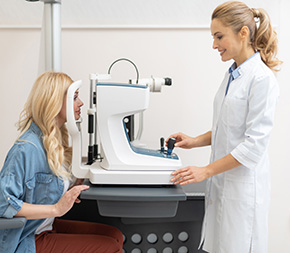
Optometric technicians play a vital, hands-on role in patient care. On a typical day in the office, OTs will perform preliminary tests, prepare patients for examinations and assist with administrative tasks so that optometrists can focus on diagnosis and treatment.
Here are the key duties you’ll be assigned working as an OT.
Responsibilities
The scope of an optometric technician’s job can vary depending on who you work for and where. The best resource you can turn to may be an actual job descriptions, so take some time to look up advertisements for this role in your city and state. As an example of a professional JD:
Let’s break down some of the most common job responsibilities for this position.
Patient preparation
Diagnostic testing
Patient education
Administrative support
Assisting with Procedures
Work environment
Optometric technicians work in a variety of eye care settings. You may find yourself working in:
- Optometrist offices:
- This is the most common setting for optometric technicians to work, offering a mix of patient interaction and administrative tasks.
- Eye clinics:
- This may be a slightly faster-paced environment with a greater focus on clinical testing and procedures.
- Retail optical stores:
- This setting may involve more emphasis on eyewear sales and customer service in addition to clinical duties.
- Hospitals:
- This is a more medically focused environment and the need for technicians in an emergency setting is usually reserved for ophthalmology technicians. If you find yourself working in a hospital, you may assist with a wider range of eye-related procedures and work closely with optometrists or ophthalmologists.
On an average day…
The workday for optometrytTechnicians is fairly structured. Scheduled appointments and well-established procedures provide a predictable routine, so you can expect to work regular business hours. Frequent interaction with patients of all ages is required, which means that those with strong interpersonal and communication skills will thrive in this role.
Optometric techs often work closely with the optometrist, other technicians and office staff, relying on collaboration and clear communication. During peak hours, there may be a sense of urgency with multiple patient exams and administrative tasks to juggle. For the most part, however, routine and order are the norm.
On any given day, you’ll spend time interacting with patients as well as working with specialized equipment for testing and measurements. Most patient data is recorded using medical charting software, which means your day will involve data entry and patient record maintenance.
In addition to note-taking and record-keeping, you’ll use digital diagnostic tools frequently. Accuracy is crucial when taking measurements, administering eye drops and providing after-visit discharge instructions to patients. Optometric techs must be thorough, efficient and pay close attention to detail.
Overall, the optometric technician work environment offers a good balance of clinical work, patient interaction and structure. The pace of work is controlled to provide an optimal patient experience.
Education for optometric techs
In some states, you can start pursuing a career as an optometric technician with a high school diploma and specialized training. Other states may require a certain number of training hours or for candidates to pass an exam. If you want to advance to higher roles, you could earn an associate degree, which takes two years of study. There are a few requirements, however, that all states share.
Essential requirements
- High school diploma or GED:
- Some Optometric Technician jobs only require a high school diploma to get started. In order to enroll in a technical or certificate program, you’ll need a diploma or GED as well. This is a baseline education requirement for most programs. A minimum grade point average of 2.0 or 2.5 is usually the threshold for entry. Specific programs may also require the completion of certain prerequisites, too, in areas like science, health science or math.
- State-specific licensing:
- Not all states require licensure or registration for optometric techs. It’s important to check the specific requirements of the state where you intend to practice, as well as the state’s licensing requirements before enrolling in any program. Where licensure is required, most states require a passing grade on a specific exam offered by a recognized national organization like the American Optometric Association (AOA). These exams cover knowledge in areas such as patient care, optics, anatomy and the use of specialized equipment.
Some states may also have requirements surrounding experience, continuing education hours or background checks. You can find information on your state’s specific requirements by visiting your state’s optometry board or regulatory agency. Websites like the AOA often have state-by-state resources on licensure as well.
Employers in states with licensure requirements often prefer certified technicians. Licensure ensures optometric technicians have the necessary knowledge and skills to provide safe and competent care. It also demonstrates your commitment to the field and may open up more career opportunities. Even in states that don’t require licensure, professional certification is highly recommended, and may make you a more desirable candidate.
Professional certification
Earning certifications may enhance your career prospects as they demonstrate a commitment to continuing in the industry and a desire to grow and learn. More than that, certification may make you stand out as a job candidate or lead to a boost in pay.
A popular option is a credential offered by the American Optometric Association-Commission on Paraoptometric Certification (AOA-CPC) called Certified Paraoptometric (CPO). This is the first step for many optometric technicians. It covers basic ophthalmic knowledge and fundamental tasks such as taking patient histories, performing visual acuity and visual field testing, administering eye drops and basic instrument use and maintenance.
This program is open to new optometric technicians. The only requirement to enroll in this program is a high school diploma or GED equivalency—no previous experience is necessary.
Another option from the AOA-CPC is the Certified Paraoptometric Assistant (CPOA). This is considered a more intermediate-level certification that builds upon the skills developed at the CPO level.
To be eligible for this program, you must:
You’ll learn about more advanced duties and a greater depth of knowledge in this certification program. Some of the topics you’ll learn more about include taking detailed case histories, performing advanced vision testing (tonometry, lensometry), assisting with minor surgical procedures and understanding ophthalmic medications and their uses.
Experiential learning
Hands-on experience is critical when it comes to any healthcare profession, and optometry is no exception. Externships or internships at optometrist offices provide valuable experience and may strengthen your resume.
Many optometric technicians learn necessary skills through on-the-job training provided by their employer. This training typically involves shadowing experienced technicians, learning how to use specialized equipment and performing patient care tasks under supervision.
Continuing education
The field of optometry is constantly evolving. Continuing education ensures you stay current with the latest advancements in technology and procedures. You may choose to continue on as an optometric technician or pursue other careers in the field, such as optician, ophthalmic technician or optometrist. Take a look at what’s required to advance in the field:
| Career path | Education | Typical duties | Work setting |
|---|---|---|---|
| Optometric technician | High school diploma and on-the-job training. Some states prefer certification. | Take patient histories, conduct preliminary eye exams, operate diagnostic equipment, assist optometrist, admin tasks | Optometrist offices, eye clinics, retail optical stores, hospitals |
| Optician | Apprenticeship or associate degree | Fit and dispense eyeglasses and contact lenses, work with prescriptions, customer service | Retail optical stores, optometrist offices, private practices |
| Ophthalmic technician | Associate degree | Broader range of duties than optometric techs, including assisting with in-office procedures, surgical prep and medical testing | Hospitals, ophthalmologist offices, eye surgery centers |
| Optometrist (OD) | Bachelor’s degree, 4-year Doctor of Optometry program, licensing exam | Primary eye care provider; diagnose and treat eye diseases, prescribe glasses/contacts, manage eye health | Private practices, eye clinics, hospitals, retail optical settings |
Optometric technician salary and job outlook
Data is not available for optometric technicians or assistants on the Bureau of Labor Statistics website. However, a look at similar careers provides a little insight into the prevailing median wage for occupations like OT.
As of 2023, Ophthalmic Medical Technicians earned a median annual salary of $44,080. Projected growth for this field was much lower than the national average for all professions—19.8%—compared to the 3% total growth expected over the next 10 years.
Medical assistants earned a median salary of $44,200 a year in 2023. According to statistics from that same year, the job outlook for this position was much brighter than average with a projection of 12.5% growth.
For this article we have applied BLS data for healthcare technologists and technicians, all others. Projected growth is anticipated to be 5.2% through 2034.
Is optometric technician the right career path for you?
If you answer yes to these questions, then a career as an optometric technician may offer a dynamic and rewarding path to contribute to the world of eye care:
- Are you detail-oriented and enjoy working with precise measurements?
- Do you have a passion for patient care and building rapport with others?
- Are you curious about the science behind vision and the human eye?
- Are you a quick learner and adaptable to new technologies?
- Can you see yourself working as part of a healthcare team in a collaborative setting?
- Are you comfortable working in a healthcare setting?
Read optometrist Dr. Meenhal Agarwal’s insights on optometric assistants
About Dr. Agarwal:
My aspiration to become an optometrist was ignited at the age of 11 when I was diagnosed with glaucoma. After completing high school, I was determined to pursue my education at the University of Waterloo, where I earned my Doctorate of Optometry.
I grew up in Markham and attended Toronto Montessori School before transitioning to Havergal College. Both schools played a pivotal role in shaping me into an independent and confident South Asian woman.
Shortly after graduating, I opened my first optometry practice and have since expanded to three locations in the Greater Toronto Area. Our team includes numerous optometric assistants, opticians, optometrists and clinic leads. As an entrepreneur, I thrive on inspiring my teams to reach and exceed their potential.
I am deeply passionate about ocular health. Sight, in my view, is our most precious sense, and the prospect of losing it is daunting. Proactively preventing or managing eye disease and supporting patients throughout their treatment is incredibly rewarding.
What she looks for in an optometric assistant:
Science and math are crucial prerequisites for a career in optometry. The curriculum in optometry school is extensively focused on physics/optics, anatomy, biology and chemistry. In Canada, there are two optometry schools—one in Waterloo and the other in Montreal—while the U.S. has several more.
If you are considering this field, I strongly recommend gaining firsthand experience by shadowing, volunteering or working in an optometry practice. I personally shadowed at two optometry practices and worked in other healthcare settings to solidify my decision to pursue this career.
My daily schedule involves seeing approximately 20 patients, with services ranging from comprehensive eye exams and contact lens fittings to myopia control exams, dry eye assessments and LASIK consultations. My optometric assistants are cross-trained in all aspects of our practice. Their responsibilities encompass a variety of administrative tasks, including scheduling appointments, patient triage, ordering contact lenses, following up on specialist referrals and reports and managing recall for patients due for follow-up. They also conduct specific pre-examination tests before the patient consults with me.
For comprehensive eye exams, this includes measuring corneal curvature and eye pressure, taking retinal photographs and performing optical coherence tomography scans. During contact lens appointments, they instruct patients on the insertion, removal and maintenance of their lenses.
They also conduct visual field testing for glaucoma patients and perform specialized assessments for dry eye, such as meibography, and assist in Radio Frequency treatments. After completing these assessments, they provide me with the results. I then meet with the patient to discuss findings and further management.
Optometric assistants are a vital component of our practices. Their collaboration is essential, enabling us to conduct numerous tests that aid in the prevention of ocular diseases. Without their support, we would not be able to provide such proactive and efficient patient care.
I value working with optometric assistants who are precise in their testing and meticulous with medical documentation—qualities that are fundamental in healthcare. Accurate testing and thorough note-taking are critical to prevent misinterpretation of results. I also appreciate team members who are reliable and understand the significant responsibility of supporting our patients who depend on them.
My ideal optometric assistants are pleasant, patient and caring. They spend significant time with patients, conducting tests and explaining procedures, so it’s crucial that they make patients feel comfortable. They must also be patient, as overcoming barriers like language differences, age and mobility issues is essential for obtaining accurate results. Caring is vital to ensure patients feel at ease throughout their visit.
I’d like to leave you with a piece of advice: Choose your career path based on your own aspirations, regardless of others’ opinions. You will spend 60% to 70% of your day at work, so it’s important to pursue what truly matters to you. Run your own race!
Taking the first step
If you’re ready to take your interest to the next level, you can start by researching a career as an optometric technician in your area. Many students feel more comfortable pursuing a career in healthcare after some technical training. You can explore local technical programs and college curriculums for optometric techs using the Find Schools button here on this page.
Next, begin to network with optometrists and technicians to gain insights into the profession. Introduce yourself to local eyecare professionals or meet professionals on networking sites such as LinkedIn. Inquire about job shadow opportunities to get a closer look at what this job entails.
From here, you can start building your skills by volunteering in healthcare settings or completing coursework or certification. This is a great way to gain valuable experience and set yourself up for success in the eyecare industry.
With dedication and a clear vision, you can embark on a fulfilling career as an optometric technician, making a difference in the lives of others, one eye exam at a time.
Resources for optometric technician students
American Optometric Association (AOA):
The AOA offers certification, continuing education, career resources and a robust online community for optometric professionals. The AOA also developed and regulates the preeminent certification options for paraoptometrists, offering four levels of Paraoptometric Certification.